
In the expansive and diverse landscape of Canadian higher education, from the coastal vibes of the University of British Columbia to the urban rigour of the University of Toronto, academic success is often determined by more than just raw data. It is an exercise in professional communication. In Canada, the way you present your findings is viewed as a direct reflection of your respect for academic integrity and the peer-review process.
Navigating these standards can be a steep learning curve for international students and domestic freshmen alike. The expectation for polished, structurally sound work begins the moment you hit “upload”. For those seeking to bridge the gap between their research and the rigorous formatting required by local rubrics, collaborating with a dedicated assignment maker Canada ensures that every technical nuance—from margin widths to regional spelling—is addressed with professional precision. This strategic support allows students to focus on deep learning while ensuring their output meets the highest institutional benchmarks.
The complexity of these standards is particularly evident in STEM fields. When documenting intricate systems, such as computer network assignments help becomes a vital resource for students tasked with translating technical topologies into formal, structured reports. Just as a network protocol requires strict naming logic to function, a Canadian academic paper requires a logical visual hierarchy to be considered authoritative.
The Philosophy of Canadian Academic Formatting
Unlike some global systems that prize volume, Canadian professors value clarity, conciseness, and “Signposting”. Signposting is the practice of using words and structural cues to guide the reader through your argument. This starts at the very foundation: the file name.
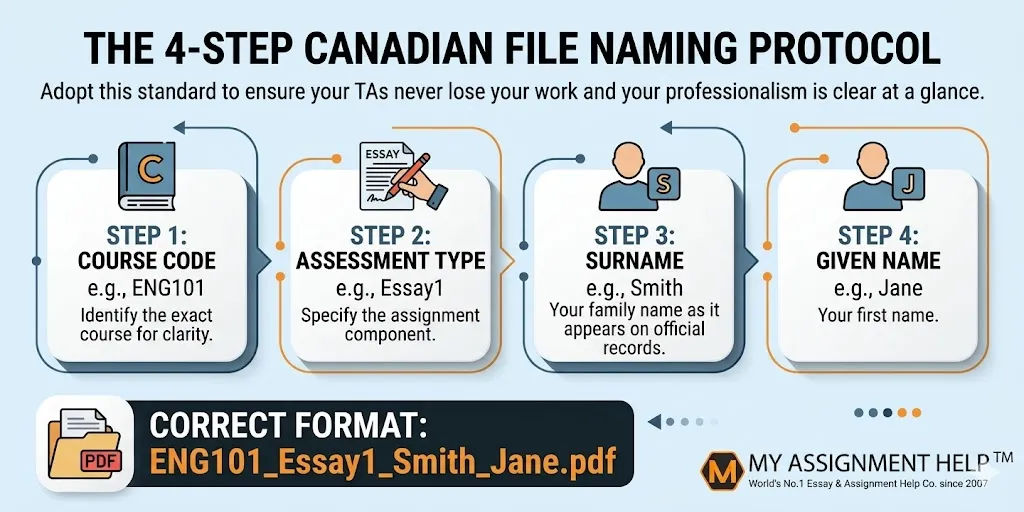
Pro Tip: Always avoid spaces and special characters like # or ! to prevent server upload errors.
Structural Pillars of a Distinction-Grade Paper
Canadian academic style is largely a hybrid of British precision and North American formatting. Depending on your faculty, you will likely encounter APA (Social Sciences), MLA (Humanities), or Chicago (History and Arts).
1. The Visual Hierarchy
A professional document must utilize the “Headings” feature of word processors. This isn’t just for aesthetics; it provides a roadmap for the reader. In Canada, an H1 header is typically centered and bold, while H2 and H3 headers are left-aligned, serving as logical breaks in the argument.
2. The ‘Bottom Line Up Front’ (BLUF) Approach
Especially in Business and Policy schools across Ontario and Quebec, the BLUF method is preferred. This means your executive summary or introduction must clearly state the conclusion before diving into the evidence. This demonstrates Expertise by showing the writer has mastered the material enough to summarize it concisely.
Data Snapshot: Formatting and Grade Correlation
Internal reviews of grading rubrics across major Canadian universities suggest that “Presentation and Formatting” usually account for 10% to 15% of the total grade. However, the indirect impact is often higher. A poorly structured paper increases the “cognitive load” on the marker, often leading to harsher critiques of the actual content.
| Criteria | Standard Expectation | Common Grade Pitfall |
| Language | Canadian English (u in colour) | Using US or UK English inconsistently |
| Citations | Perfect hanging indents | Incomplete URLs or missing dates |
| Digital Format | PDF (for stability) | Uploading .pages or .txt files |
| Font/Spacing | Times New Roman / Double Space | Using “decorative” fonts |
Technical Documentation in Network Engineering
For technical students, document structure mirrors the logic of the subject. In computer networking, reports must follow a lifecycle: Requirement Analysis, Design, Implementation, and Testing. Using expert computer network assignments help can ensure that these technical reports include properly named diagrams and tables of figures, which are essential for Authoritativeness in engineering faculties.
Key Takeaways for Success in Canada
- Adopt the Local Tongue: Set your document language to “English (Canada)”. This ensures ‘organise’ becomes ‘organize’ and ‘theatre’ stays ‘theatre’.
- Structure with Purpose: Every paragraph should follow the PEEL method (Point, Evidence, Explanation, Link).
- The “Three-Second” Rule: A professor should know who you are and what the assignment is within three seconds of looking at your cover page.
- Integrity is Non-Negotiable: Use structure to clearly separate your ideas from your sources.
Frequently Asked Questions (FAQ)
Should I include my Student ID in the file name?
In most Canadian institutions, yes. The safest format is: Course_Assignment_Name_StudentID. Verify with your syllabus first.
Why is PDF preferred over Word?
PDF ensures that your carefully crafted margins, fonts, and images look exactly the same on the professor’s screen as they do on yours. Word files can shift formatting depending on the software version.
Does the choice of font really matter?
Yes. Stick to “The Big Three”: Times New Roman, Arial, or Calibri. Using “handwriting” or “comic” fonts is viewed as a lack of professionalism in Canadian academia.
References & Academic Sources:
- University of Guelph Writing Services (2024). “Effective File Naming and Organization.”
- Simon Fraser University Student Learning Commons. “The Canadian Academic Writing Style Guide.”
- Statistics Canada (2023). “Trends in Digital Submission and Academic Evaluation.”
- Association of Canadian Publishers. “Standards for Professional Documentation in Higher Ed.”
About the Author:
The author is a Senior Education Consultant at MyAssignmentHelp. With extensive experience in the Canadian academic sector, they specialize in helping students optimize their research and documentation strategies to meet the evolving standards of North American universities.